


Why Most Adult Training Fails Before It Even Starts
Inspired by the motivational frameworks and strategies presented in Enhancing Adult Motivation by Raymond J. Wlodkowski.
Picture a room full of adults on the first day of a course. Maybe it’s a college classroom, maybe a corporate training session, maybe an online workshop. The instructor is competent. The material is solid. The slides are polished. And yet, within twenty minutes, half the room has mentally checked out.
We usually blame this on “engagement problems” or “adult attention spans.” But what if the real issue isn’t attention at all — it’s that almost nobody in that room ever asked, out loud, whether the learners felt like they belonged there in the first place?
That question — not “how do I make this more interesting?” but “how do I make this feel like it matters to this person, in their world?” — is the quiet obsession running through Raymond J. Wlodkowski’s Enhancing Adult Motivation to Learn. It’s not a book about teaching techniques in the usual sense. It’s a book about what actually happens, biologically and culturally, in the moment someone decides whether to lean in or shut down.

A Book Built Around One Uncomfortable Question
Wlodkowski, a psychologist and longtime adult educator, spends over five hundred pages circling a single, deceptively simple question: how do you help all adults want to learn?
Not “how do you make them learn.” Want to. That distinction matters more than it first appears. Most instructional design — in universities, corporate L&D, professional certification programs — treats motivation as someone else’s problem. Either the learner brings it, or they don’t. The instructor’s job is to deliver content; the learner’s job is to care.
Wlodkowski rejects this division entirely. His argument, backed by decades of classroom experience and a fairly serious dive into neuroscience, is that motivation isn’t something learners either have or lack. It’s something environments create or destroy, moment by moment. And because every learner carries a different cultural history into that environment, motivation can never be separated from culture. What excites one learner can alienate another, not because of laziness or attitude, but because of how differently people have been taught to interpret respect, participation, effort, and even silence.
This is the premise the rest of the book builds from: if motivation is created rather than found, then it can be designed for — deliberately, systematically, and across every kind of classroom.

The Framework at the Heart of the Book
The central contribution of the book is something Wlodkowski developed with fellow educator Margery Ginsberg back in the 1990s: the Motivational Framework for Culturally Responsive Teaching. It rests on four conditions that, according to the book, need to be present — in roughly this order — for intrinsic motivation to take hold during any learning experience.
Inclusion comes first. Before people can care about what they’re learning, they need to feel like they’re not outsiders in the room. This isn’t about icebreakers for their own sake — it’s about learners sensing, often within minutes, whether their presence and perspective are actually welcome or merely tolerated.
Attitude comes next. Once someone feels included, the question becomes whether they believe the subject is relevant and whether they believe they’re capable of succeeding at it. A learner who feels excluded won’t even get to this stage; a learner who feels included but doubts their own competence will disengage just as quickly, only more quietly.
Meaning takes over during the learning itself. This is where attention has to be earned and re-earned — through relevance, challenge, story, curiosity, even humor — because interest doesn’t stay switched on by default. It has to be actively sustained.
Competence closes the loop. Learners need to walk away knowing, not just being told, that they’ve actually gotten better at something they value. Without that felt sense of growth, even an enjoyable learning experience can leave people wondering what the point was.
What makes this more than a tidy four-box model is Wlodkowski’s insistence that these conditions aren’t independent techniques you sprinkle into a lesson plan. They interact. A brilliantly designed activity for building meaning will fail if inclusion was never established. A perfectly fair assessment won’t build competence if the learner never developed a workable attitude toward the subject in the first place. The framework only works as a system — which is exactly why so many well-intentioned training programs, full of individually good ideas, still don’t move the needle on motivation.

The Brain Doesn’t Lie About What It Cares About
One of the more unexpected pleasures of this book is how seriously it takes neuroscience — not as decoration, but as evidence. Wlodkowski walks through how neurons, synapses, and neurotransmitters like dopamine physically shape what we pay attention to and remember. The now-familiar phrase “neurons that fire together wire together” gets real weight here: it explains why you cannot simply argue someone out of a belief or into enthusiasm. Attitudes are literally built into neural networks over time, through repetition and emotionally significant experience — not through a single well-worded explanation.
This has a humbling implication for anyone who has ever tried to “convince” a resistant learner with logic alone. If a learner walks in believing they’re bad at math, or that a certain subject “isn’t for people like them,” a clear explanation of why they’re wrong will rarely undo that belief on the spot. What’s needed is a different kind of experience, repeated enough times, to physically compete with the old network. This is one of the book’s quieter but more radical claims: teaching well is less about information transfer and more about engineering new experience.
The neuroscience also explains why emotion is treated as central rather than incidental throughout the book. Moments that carry emotional weight — curiosity, mild challenge, connection, even carefully used humor — are the ones the brain flags as worth keeping. A technically accurate but emotionally flat lecture, by contrast, is the kind of information the brain is biologically wired to discard.
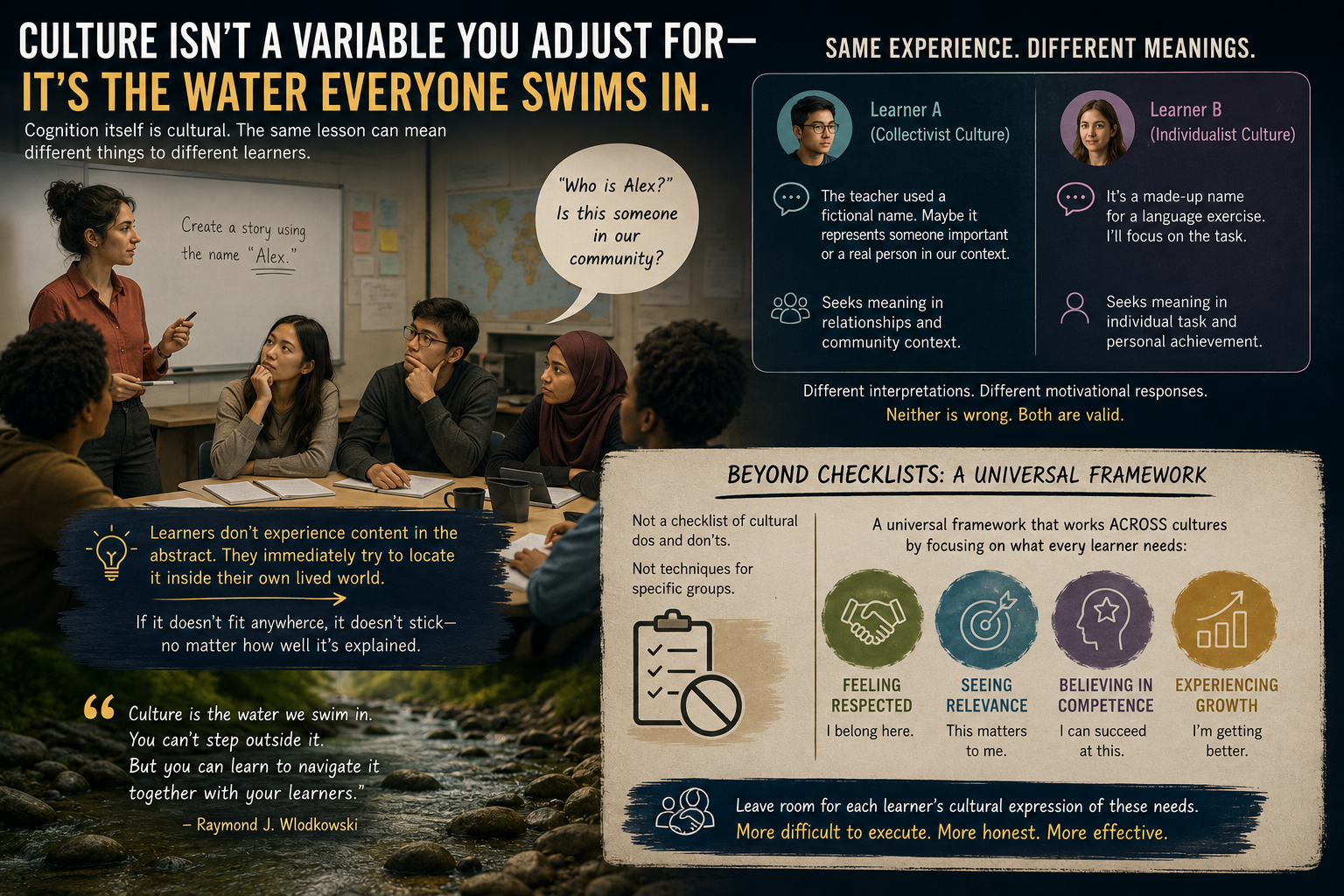
Culture Isn’t a Variable You Adjust For — It’s the Water Everyone Swims In
It would be easy to reduce “culturally responsive teaching” to a checklist: acknowledge different backgrounds, avoid stereotypes, diversify your examples. Wlodkowski’s version is more demanding than that.
His argument is that cognition itself is cultural — the way people interpret feedback, hierarchy, participation, even the emotion of frustration, is shaped by the cultural context in which they were raised. Two learners can go through the identical exercise and come away with completely different motivational responses, not because one is more capable, but because their cultural frameworks assign different meaning to the same event.
This is where the book’s early story of an English-language class stands out. When a teacher used a fictional name during a language exercise, the students paused the lesson entirely to figure out who this invented person might actually be within their own community. It’s a small moment, but it reveals something instructors often miss: learners don’t experience content in the abstract. They immediately try to locate it inside their own lived world. If it doesn’t fit anywhere, it doesn’t stick — no matter how well it’s explained.
This is also why Wlodkowski deliberately avoids a “microcultural” approach — prescribing specific techniques for specific ethnic or cultural groups. Instead, his framework is built to work across cultures by focusing on the universal psychological needs (feeling respected, seeing relevance, believing in one’s competence) that every learner shares, while leaving room for each learner’s specific cultural expression of those needs. It’s a more difficult approach to execute than a checklist, but arguably a more honest one.
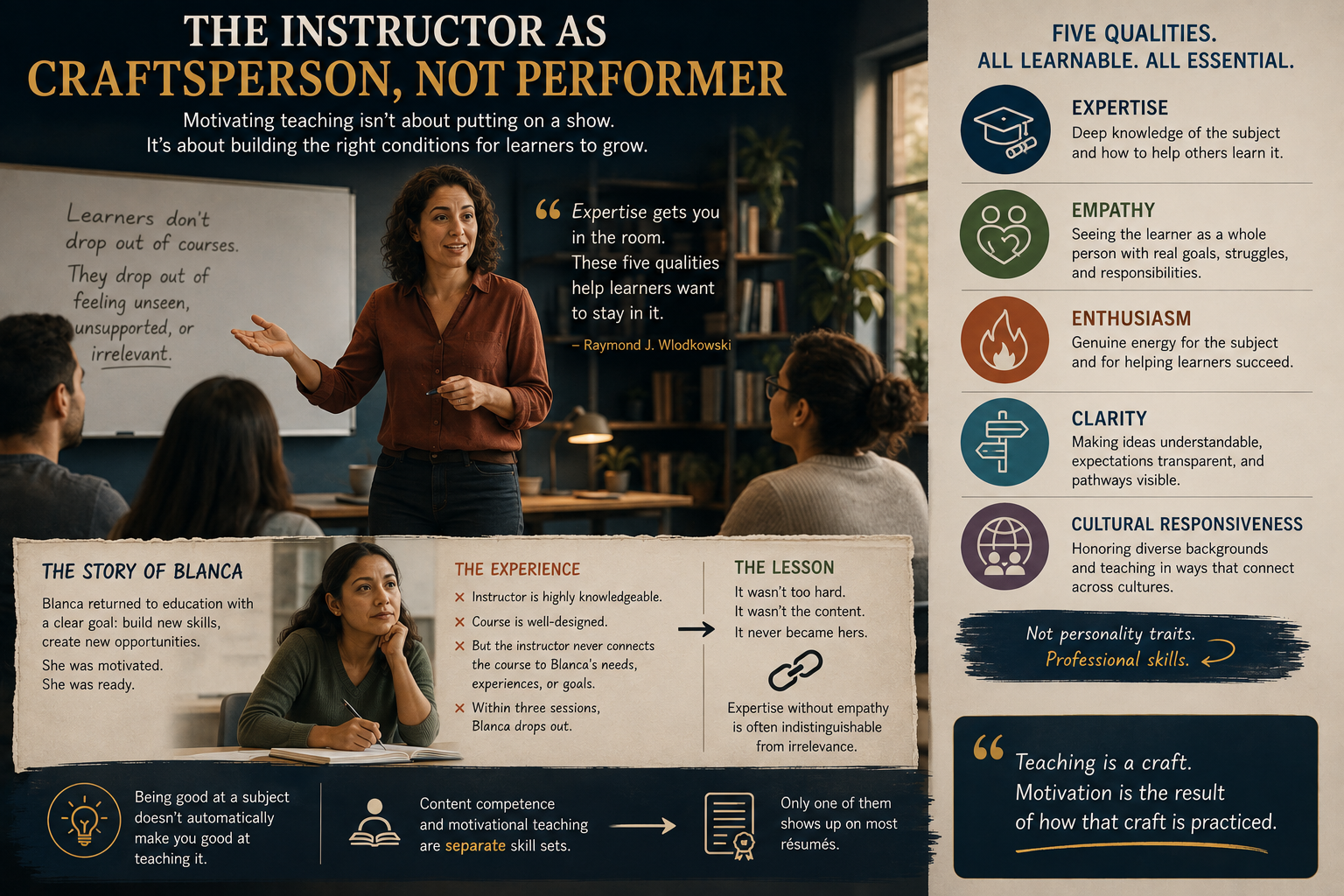
The Instructor as Craftsperson, Not Performer
If the framework is the book’s skeleton, its account of what makes an individual instructor motivating is its heart. Wlodkowski names five qualities — expertise, empathy, enthusiasm, clarity, and cultural responsiveness — and insists, somewhat unusually, that all five are learnable skills rather than fixed personality traits.
The story used to illustrate this is worth sitting with. An adult learner named Blanca signs up for a communications course, genuinely motivated to build new skills after years away from formal education. The instructor is clearly knowledgeable — expert, even — but never adjusts to what she actually needs from the course. Within three sessions, she quietly drops out, not because the material was too hard, but because it never became hers. Expertise without empathy, the book suggests, is often indistinguishable from irrelevance.
There’s something quietly confronting in this for anyone who has ever assumed that being good at a subject automatically makes someone good at teaching it. Wlodkowski’s answer is no — competence in content and the ability to evoke motivation are separate skill sets, and only one of them shows up on most résumés.

Why This Still Matters Outside the Classroom
You don’t have to be a professional educator to find use in this book. Anyone who has ever run a team meeting, onboarded a new hire, mentored a junior colleague, or tried to get a family member excited about learning something new is, in Wlodkowski’s terms, managing motivation whether they realize it or not.
The framework translates surprisingly well to workplace settings. A new employee who feels like an outsider in their first week (inclusion failure) will struggle to engage with even well-designed training. A team member convinced they “aren’t a numbers person” will avoid a task long before anyone assesses their actual ability (attitude failure). And plenty of well-run projects fizzle simply because no one ever helped participants feel — not just hear — that they’d actually gotten better at something.
A Fair Word of Caution
The book is not effortless reading. It’s dense with citations, occasionally academic in tone, and its 60 strategies — while genuinely useful as a reference — can feel more like a manual to be consulted than a narrative to be read cover to cover. Readers looking for a quick, breezy self-help take on motivation may find its rigor slower going than expected. But that same rigor is exactly what gives its claims weight; this isn’t a book of hunches, it’s a synthesis of research, practice, and biology built over decades.

What to Actually Take With You
A few ideas from this book are worth carrying into any teaching, training, or mentoring situation you’re part of:
- Motivation is not a fixed trait in the learner — it’s a condition created (or destroyed) by the environment around them.
- Sequence matters. Belonging and attitude have to be addressed before content can land.
- You cannot argue someone out of disengagement. You have to give them a different experience.
- Culture shapes how people interpret every part of a learning experience, not just the content itself.
- Being knowledgeable and being motivating are not the same skill — and only one of them is usually taught.
The Real Question the Book Leaves You With
Strip away the neuroscience, the strategies, and the framework, and Enhancing Adult Motivation to Learn is really asking something much simpler: when was the last time you walked into a room — as a teacher, a manager, or a learner — and someone made you feel like you actually belonged there before they asked anything of you?
If you can’t remember, that’s not an accident. And if you’re the one running the room next time, the book’s real challenge is this: are you going to leave that feeling to chance again?

Read It. Explore It. Apply It.
Loved the ideas in this book?
There’s more to discover.
Ascent Path.AI is trained on the principles and insights explored in books like this—helping you go beyond reading and explore how these ideas can apply to your own journey.
Continue exploring with AscentPath.AI
And if you’re hungry for more, discover our other book insights and articles.

