


When Training Isn’t the Answer: Rethinking How People Learn and Perform
Inspired by the research in Design for How People Learn by Julie Dirksen.
A team keeps missing the same deadline. Leadership’s answer: schedule a time-management workshop. Everyone attends. Everyone nods along. Two months later, the same deadlines are missed the same way.
Or a company rolls out new software, backs it with a thorough training video, and watches half the team quietly keep using the old workaround they’ve always used, because it’s faster and nobody’s actually stopped them. Both stories have the same root cause, and it isn’t a training problem. It’s a diagnosis problem.
Julie Dirksen, a learning strategist who has spent years designing training for organizations ranging from Fortune 500 companies to nonprofits, opens her book Design for How People Learn with a question most training programs skip entirely: before you build a course, do you actually know what’s standing between people and better performance? Because very often, she argues, it isn’t a lack of knowledge at all — and a course built to fix a knowledge gap does almost nothing for a gap that was never about knowledge in the first place.
The Core Idea: Not Every Problem Is a Knowledge Problem
If people already know what to do and still aren’t doing it, teaching them again won’t help.
Dirksen’s central argument is that “training” has become the default answer to almost any performance problem, regardless of what’s actually causing it. But a performance shortfall can come from several very different places: people might genuinely lack the knowledge, or they might have the knowledge but lack the skill to apply it under pressure, or they might have both and simply lack the motivation, or the habit, or a workplace environment that actually supports the new behavior.
Pour a knowledge-focused course onto a motivation or environment problem, and you get exactly what so many organizations experience: a well-reviewed training session that changes nothing.
The fix starts with a simple discipline — figuring out which gap you’re actually dealing with before deciding what to build.
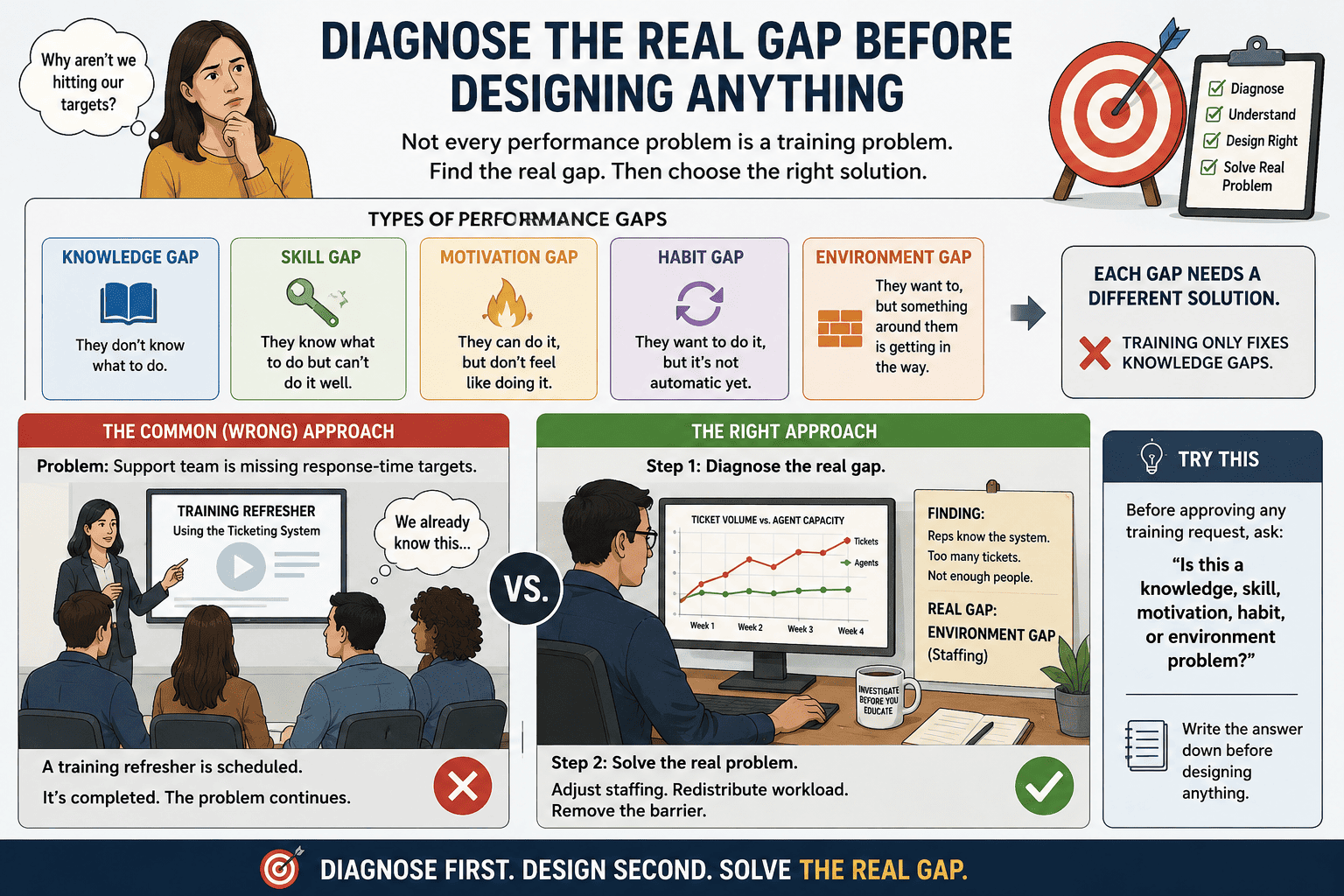
1. Diagnose the Real Gap Before Designing Anything
What it means: Performance problems usually fall into one of several categories — a knowledge gap, a skill gap, a motivation gap, a habit gap, or an environment gap — and each one calls for a completely different solution. A course only addresses one of these well: knowledge.
Why it matters: Most training requests skip straight to “let’s build a workshop” without ever asking what’s actually missing. If the real issue is that people don’t have time, don’t have the right tools, or simply haven’t built the habit yet, a course addresses none of that.
See it in action: A support team is missing its response-time targets. The instinctive fix is a training refresher on the ticketing system. But a closer look reveals the reps already know the system well — they’re just juggling too many open tickets at once because staffing hasn’t kept pace with ticket volume. No amount of retraining fixes a staffing problem.
Try this: Before approving any training request, ask directly: is this a knowledge problem, a skill problem, a motivation problem, or an environment problem? Write the answer down before designing anything.
2. Meet the Elephant Before You Talk to the Rider
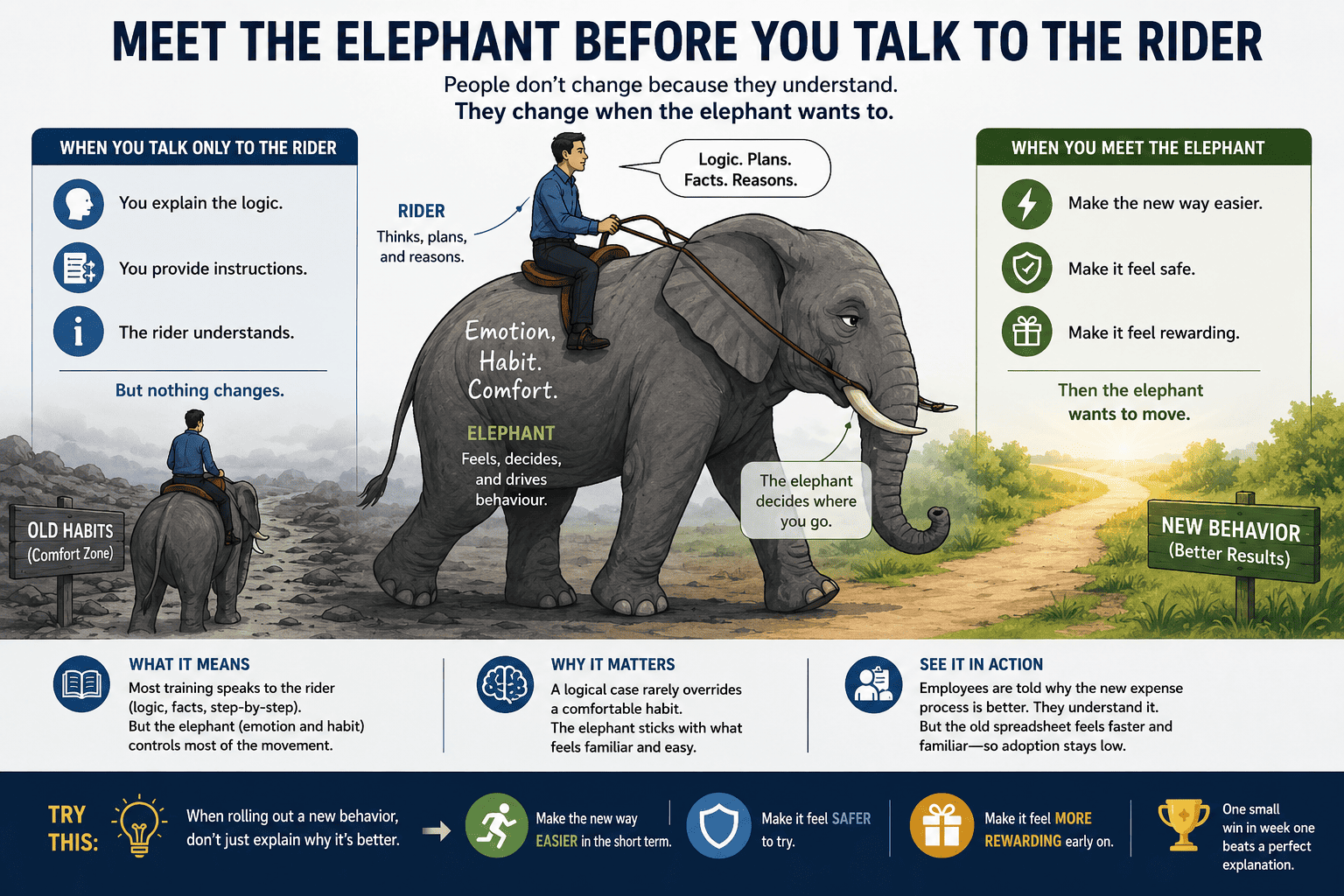
What it means: Dirksen borrows a well-known metaphor for the mind: a rational “rider” who plans and reasons, sitting atop an emotional, habit-driven “elephant” who actually controls most of the movement. Most training speaks only to the rider — logic, facts, step-by-step instructions — while the elephant, running on emotion and existing habit, quietly does whatever it wants.
Why it matters: Knowing the right thing to do and actually doing it are governed by different parts of the mind. A perfectly logical explanation of why a new process is better rarely overrides the pull of an existing habit that already feels comfortable and familiar.
See it in action: Employees are told, correctly and clearly, why a new expense-reporting process reduces errors and saves everyone time. The explanation is airtight. Adoption still crawls, because the old spreadsheet is familiar, feels faster in the moment, and doesn’t require overcoming any resistance to something new.
Try this: When rolling out a new behavior, don’t just explain why it’s better — make the new way feel easier, safer, or more rewarding in the short term than the old habit. A tiny quick win in week one does more than a well-reasoned memo.
3. Design for Doing, Not Just for Knowing
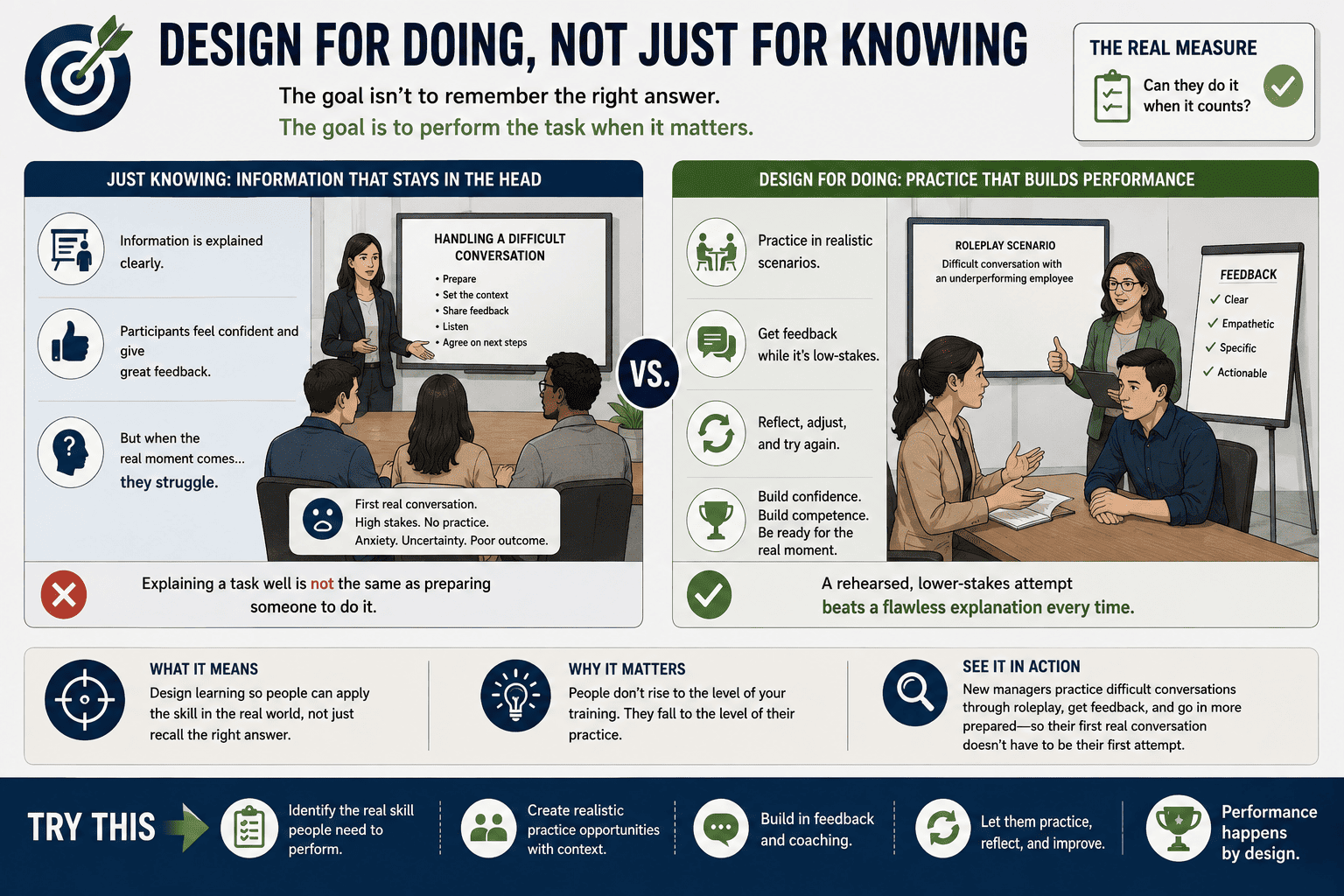
What it means: The real measure of a learning experience isn’t whether someone can recite the right answer afterward — it’s whether they can actually perform the task under real conditions. Knowledge that never turns into action was never really the point.
Why it matters: It’s entirely possible to deliver information clearly, get glowing feedback scores, and still fail to prepare anyone to perform. Explaining a task well and preparing someone to do that task are different design goals, and most training accidentally optimizes for the first one.
See it in action: A new manager training explains, in careful detail, how to handle a difficult conversation with an underperforming employee. It’s a great explanation. But the first time that manager actually has to have the conversation, in the room, with real stakes, is also the first time she’s ever attempted it — which is the worst possible moment to be a beginner.
Try this: Wherever possible, replace “explain the skill” with “practice the skill under realistic conditions, with feedback.” A rehearsed, lower-stakes attempt beats a flawless explanation every time.
4. Attention Has to Be Earned
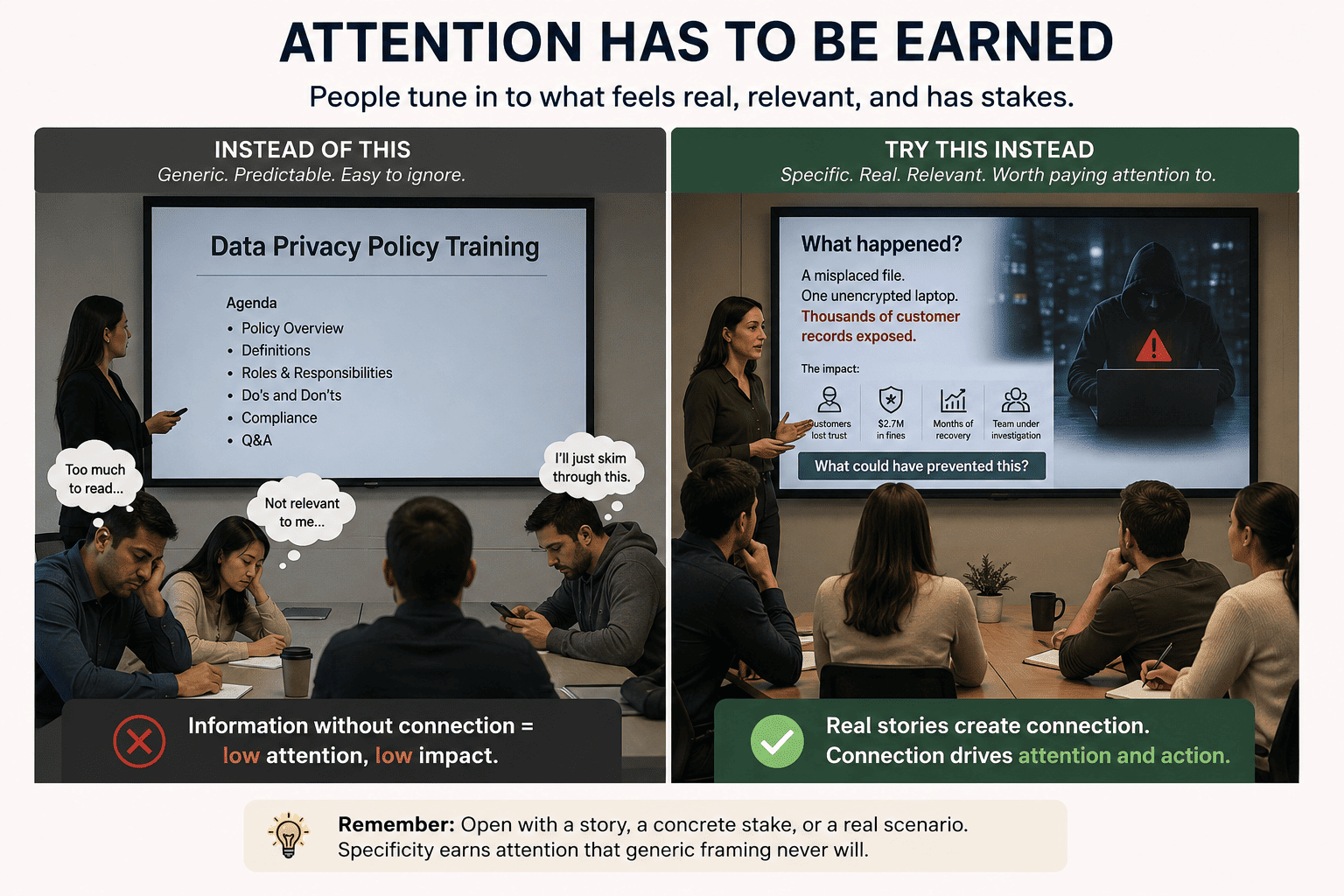
What it means: People don’t pay attention just because information is important or well-organized. Attention responds to relevance, story, novelty, and stakes that feel real — the same emotional “elephant” that drives behavior also decides what’s worth paying attention to in the first place.
Why it matters: A technically accurate, comprehensive training module that nobody actually engages with produces the same result as no training at all. Dense, generic content is easy to skim past and easy to forget.
See it in action: Instead of a generic slide deck on data privacy policy, a training opens with a short, specific story about a real (anonymized) incident where a small mistake led to a serious data exposure — then walks through exactly what would have prevented it. The policy content is identical. The engagement isn’t.
Try this: Open any training with something specific and real — a story, a concrete stake, an actual scenario — instead of an agenda slide. Specificity earns attention that generic framing never will.
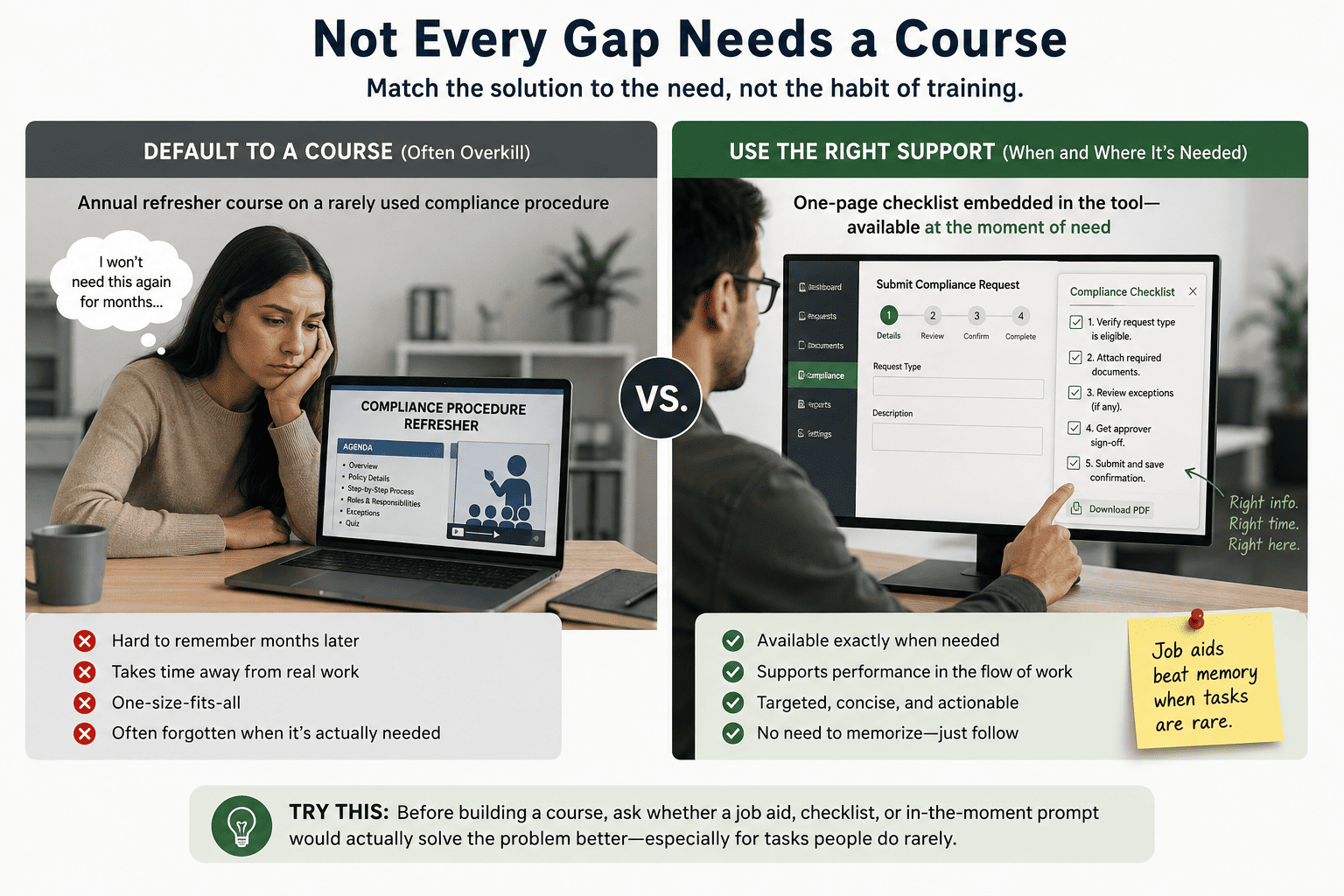
5. Not Every Gap Needs a Course
What it means: Sometimes the best solution isn’t training at all — it’s a well-placed reference tool, a checklist, a template, or a quick prompt available exactly when someone needs it, so they don’t have to memorize the information in advance.
Why it matters: Organizations often default to training even for tasks people only perform occasionally, where memorization was never realistic in the first place. Building a full course for something people do twice a year is a poor use of everyone’s time.
See it in action: Instead of an annual refresher course on a rarely used but important compliance procedure, a company builds a one-page checklist that lives directly inside the tool where the procedure happens — available at the exact moment someone needs it, with no need to recall it from memory months later.
Try this: Before building a course, ask whether a job aid, checklist, or in-the-moment prompt would actually solve the problem better — especially for tasks people do rarely.
How to Apply This Starting Monday
- Diagnose before you design. Name the specific gap — knowledge, skill, motivation, habit, or environment — before building anything.
- Give new behaviors a short-term win, not just a long-term justification, to compete with the pull of existing habits.
- Replace explanation with practice wherever the real skill involves doing something under pressure, not just knowing about it.
- Open with something specific and real instead of a generic agenda, to actually earn attention.
- Ask whether a checklist or job aid would beat a course, especially for anything people do infrequently.
Why This Matters Right Now
As companies lean harder on e-learning, AI-assisted onboarding, and self-paced modules, it’s become easier than ever to produce polished-looking training quickly — and easier than ever to produce polished training that solves the wrong problem. Volume of content isn’t the bottleneck anymore; diagnosis is.
Remote and hybrid work also removes a lot of the natural, in-the-moment coaching that used to happen simply by sitting near someone experienced. That makes it more important, not less, to design learning experiences that account for real behavior, real attention spans, and real workplace friction — rather than assuming a well-written explanation will be enough on its own.
Key Takeaways
- Not every performance problem is a knowledge problem, and a course only fixes knowledge gaps well.
- Logical explanations speak to the rational mind; behavior is often driven by the more emotional, habit-driven part of it.
- Design learning experiences around doing the task, not just understanding it.
- Attention has to be earned through relevance and specificity — it isn’t automatic.
- Sometimes a simple job aid solves a problem faster and more durably than a full training course.
The Bottom Line
Most failed training isn’t a failure of delivery — it’s a failure of diagnosis. Before building another course, the more useful question is often the simplest one: what’s actually standing in the way, and is a course really the thing that removes it? Sometimes the answer is yes. Just as often, the real fix is smaller, cheaper, and far more likely to work.
Frequently Asked Questions
Is this book only useful for instructional designers? No. The gap-diagnosis approach is just as useful for managers deciding how to address a performance issue on their team as it is for someone formally designing a course.
How do you tell a motivation gap apart from a habit gap? A motivation gap usually shows up as people understanding and being capable of the new behavior but not wanting to prioritize it. A habit gap shows up as people intending to do the new behavior and still defaulting to the old one automatically, often without noticing.
Doesn’t storytelling in training risk feeling gimmicky? It can, if it’s generic. The distinction is specificity — a vague, inspirational anecdote feels gimmicky, while a concrete, relevant scenario tied directly to the content earns genuine attention.
What if leadership insists on a full course even when a job aid would work better? It helps to frame the comparison in terms of outcomes: a job aid available at the moment of need often produces better real-world performance for routine tasks than a course people have to recall from memory weeks or months later — and it usually costs less to build and maintain.
Does this approach apply to self-paced or asynchronous learning too? Yes — arguably more so. Without a live instructor to read the room and adjust, self-paced learning depends even more heavily on getting the diagnosis, motivation design, and practice opportunities right from the start.
References & Further Reading
- Dirksen, J. Design for How People Learn. New Riders.
- getAbstract, Design for How People Learn — summary and core arguments: getabstract.com
- The Learning Guild, Book Review: Design for How People Learn, by Julie Dirksen: learningguild.com
- Learnovate Centre, Design For How People Learn with Julie Dirksen (author interview): learnovatecentre.org
- Google Books — Design for How People Learn, overview and chapter themes: books.google.com
- The Rabbit Hole, Design for How People Learn by Dirksen Julie — chapter-level summary: blas.com
Read It. Explore It. Apply It.
Loved the ideas in this book?
There’s more to discover.
Ascent Path.AI is trained on the principles and insights explored in books like this—helping you go beyond reading and explore how these ideas can apply to your own journey.
Continue exploring with Ascent Path.AI
